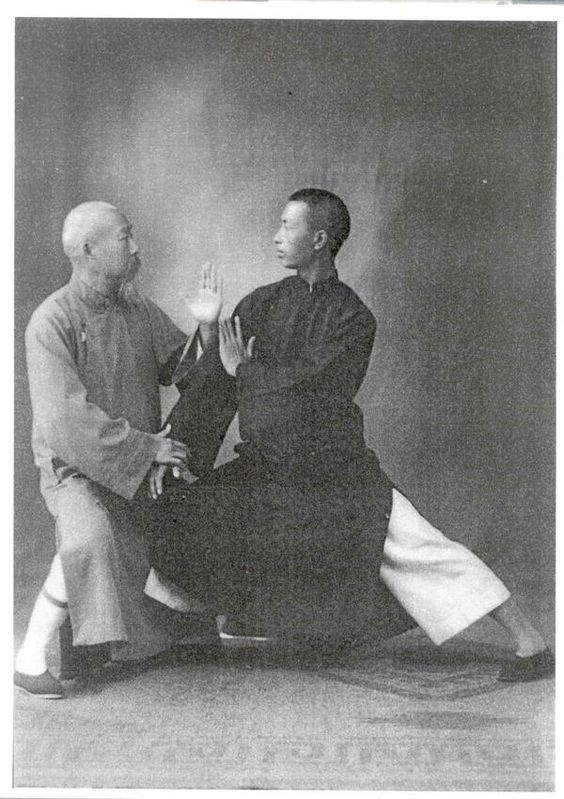
Tai Chi Martial Arts – Tui Shou (Push Hands)
Tui Shou, or Push Hands, is Tai Chi’s method of awareness and energy training. It develops Ting Jing — listening energy — the ability to sense, interpret, and respond to force through touch. Students learn to stick, connect, neutralise, deflect, and open their partner’s line of attack while maintaining balance and structural integrity.
Training begins slowly to ensure correct body alignment, rooting, and relaxation. True sensitivity can only arise when the arms and hands soften completely, releasing unnecessary tension so the opponent can be read through feel rather than sight. This foundational stage develops the primary hands — the part of the arm from below the elbow to the fingertips.
Primary and Corner Hands
In the next stage, students learn corner hands, which support and extend the skills of the primary hands. Corner hands involve guarding against the opponent’s elbow and using one’s own elbow for neutralising and projecting techniques in both defence and attack.
When the lower arms engage, the elbows become a second set of hands — hence the name corner hands. These skills build upon the first section, introducing more complex manoeuvres to override an opponent’s attack. Over time, students learn to respond through touch alone, adapting to different angles, intensities, and directions of force.
Corner hands also incorporate other parts of the body — hips, shoulders, and torso — used in the same way as the elbow. Throughout this training, the principle of stick remains central; it is one of the most important skills in Tai Chi Chuan.
Structure Testing and Rooting
Structure testing is then introduced. This teaches the art of rooting while applying the skills learned in the first two sections. Sensitivity alone is useless if a student collapses, loses balance, or is pushed back upon contact.
In Tai Chi, soft does not mean weak. Softness is a method of absorbing, neutralising, deflecting, or nullifying incoming force. To become soft, one must first become structurally strong — a paradox at the heart of Tai Chi training: “Softness within strength.”
Through structure testing, students begin to understand rooting more deeply. They learn to relax without losing stability, and to channel, absorb, or drain force. Channelling allows the practitioner to let the opponent’s force pass through, grounding it and returning it simultaneously — a method known as “swallow and spit.”
Developing Peng Jing and Internal Power
Tai Chi’s partnered work differs greatly from other martial arts and must be felt to be understood. This section builds internal power while developing Peng Jing — the expansive, resilient energy used to uproot an opponent and control their centre.
Students cultivate the essential skills of:
- Grounding
- Softening
- Absorbing
- Projecting
- Maintaining connection
- Controlling the centre
Through Tui Shou, practitioners learn to harmonise with force rather than oppose it, embodying the internal principles that define Tai Chi as a martial art.