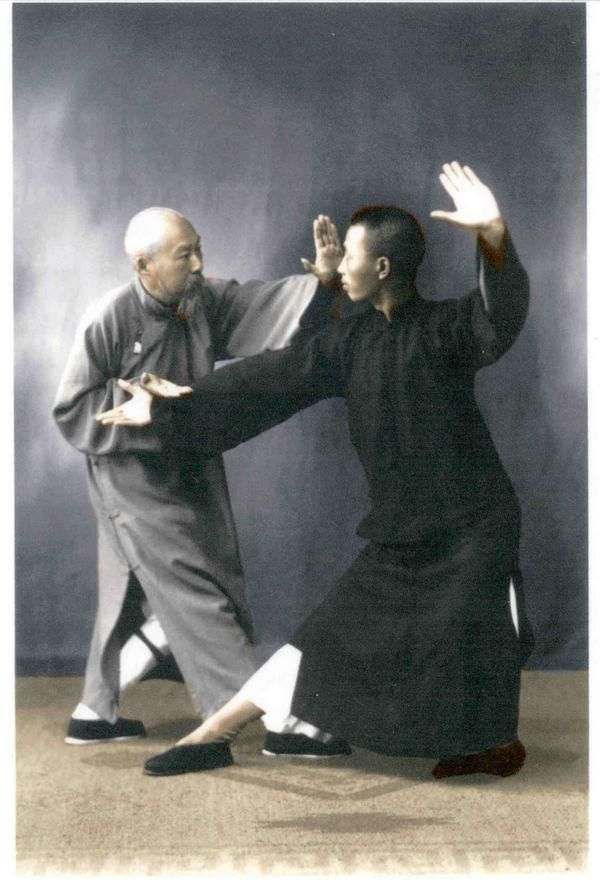
The word Men translates as “gate.” Ba Men means “Eight Gates,” and Ba Men Chuan refers to the “Eight Gate Fist/Hands.” These eight fundamental energies form the core of Tai Chi’s martial framework. Each expresses a distinct quality of force, yet all are rooted in the foundational energy of Peng.
PENG — Ward Off
Peng, often translated as “ward off,” is better understood as an expanding force. It is a 360‑degree outward expansion of energy, projected from the centre and supported by the spine, legs, and rooted feet. This buoyant, structural energy underlies all other gates.
LÜ — Rollback / Diverting
A pulling or yielding motion that redirects incoming force. Although it appears soft, Lü is supported by Peng; without Peng, Lü collapses.
JI — Press / Squeeze
A squeezing or pressing motion, often expressed as a coordinated double‑handed force. Ji is essentially a converging form of Peng, directing expansion into a focused line.
AN — Push / Press Down
A downward or forward pressing motion used to control or suppress an opponent’s force. An is not simply pushing; it is Peng energy expressed through a sinking, stabilizing direction.
CAI — Pluck / Seize
A locking or seizing force used to disrupt balance or break structure. Cai contains Peng as its stabilizing base, allowing the plucking motion to be sharp, precise, and controlled.
LIE — Split / Separate
A splitting or dividing force that sends energy in two opposing directions. Lie separates the opponent’s structure, and like all gates, it is supported by Peng’s expansive integrity.
ZHOU — Elbow
Elbow energy used for striking, uprooting, pulling, or pushing. Zhou is close‑range power, and Peng provides the internal support that makes the elbow force stable and effective.
KAO — Shoulder / Body Strike
A body‑based attack using the shoulder, hip, back, or any part of the torso. Kao expresses whole‑body power through contact, and it too contains Peng as its underlying structure.